Discovering Stored Treasures

Discovering Genealogy, One Ancestor at a Time.
Showing posts with label Max Crane. Show all posts

Friday, May 24, 2013

Friday's Faces From The Past: Sarah and David Appell

Friday's Faces from the Past: Today's faces from the past are not relatives but two people who crossed paths with my now notorious ancestor Max Crane, Mr. and Mrs. David A. Appell.  I found this article, thanks to Thomas Sewell an Ancestry.Com member and descendant of the Appell's, who has generously agreed to let me share this article with my readers.

The story of Max's employers, sheds some light onto his early years as a grocery clerk. In 1909, the year he was beaten by Waskowitz, a former employer, he was employed at Appell's New Britain store.

Couple Observing Wedding Today

1945

Mr. and Mrs. David A. Appell Were Married In Colchester In 1892


Mr. and Mrs David A. Appel of 227 Main Street are quietly observing their 50th wedding anniversary today at their home. Sunday the immediate family will gather for an anniversary dinner.

The couple were married August 22nd, 1892, in Colchester where they both were employed in a bootmaking factory. Mrs. Appel is the former Sarah R. Appelbaum and was born in Warsaw, Poland in 1872. Mr. Appell was born in Rostov, Russia in 1870. Both came to this country in 1890 and first settled in Colchester, becoming citizens in 1895. Shortly after their marriage they were partners in various business enterprises, chiefly the merchandising of food products. In 1895 they settled in New Britain where they were proprietors of a meat and grocery business for approximately 20 years.

In 1915 they came to Bristol where they have lived since. Their first grocery and meat establishment, The Bristol Public Market, was located on the site of the present Glynn Shoe Store on North Main Street. A second store carrying the same food products was soon afterwards located in the Palomba block on lower Main Street. Twenty Six years ago the two stores were combined and moved to the present location.

Mr. Appell in later years did all possible to promote and advance the idea of a super-market. Mrs Appell during the many years of their business has taken an active part. She was cashier of the present store until her retirement three years ago. Six months ago Mr. Appell retired from active business life.

Both in New Britain and Bristol they have participated in many religious and charitable affairs.

Mr. Appell is a member of Beth Israel Synagogue, the Knights of Khorassan, Bristol Lodge of Elks, No. 1010, B.P. O. E', the Knights of Pythias and the Odd Fellows. Mrs Appell is a member of the Order of Hadassah and the Women's Auxiliary of the Beth Israel Synagogue.

Traveling, fishing and sport life in general have always interested Mr. Appell. Mrs. Appell takes keen interest in flowers and traveling.


They have four children: Paul H. Appell, Morris Appell, Mrs. Lewis H. Opolinsky, and all of this city, and Mrs. Harr I. Rifchin of Boston, Mass. There are seven grandchildren.

It sounds like, the Appells were completely different kinds of employers than Waskowitz was. While Waskowitz was in the papers repeatedly for shading dealings, the Applells were upstanding citizens. Their grocery store was a much larger operation than Waskowitz's. The couple owned two stores, one on West Main, the second, where Max worked, on Myrtle Street.  Their business must have been more successful  as they could afford to take out an advertisement they placed in the city directory. This ad even suggests that they were possibly wholesalers as well, since they were "dealing" with meats and groceries. 

Ancestry.com. U.S. City Directories,
New Britain City Directory 1909 p. 116
.Provo, UT, USA: Ancestry.com Operations, Inc., 2011.
Ancestry.com. U.S. City Directories, New Britain City Directory, 1909 p. 37
Provo, UT, USA: Ancestry.com Operations, Inc., 2011.

The fact that Sarah Applebaum was involved from the business from the outset, is remarkable. I'd like to think that she kept a mother's eye on the young Max and may have helped him recover after the beating. After all, Max was not only working at the 459 Myrtle Street store, he was also living there!
Ancestry.com. U.S. City Directories,
New Britain City Directory, 1909 p. 288
Provo, UT, USA: Ancestry.com Operations, Inc., 2011.
I hope, you enjoyed the latest installment of the Max Crane story! Have a wonderful weekend.

Wednesday, April 10, 2013

Part IV: The Max Crane Mystery Continues

Part IV:

Driving past New Britain, I shared the latest discoveries of the Max Crane story with my aunt and uncle. We were heading to a funeral and unfortunately had no time to explore our ancestral town. The New Britain roots trip  remains in planning mode. In the meantime, as promised, the newest research developments.

Last week's understanding of two key early 20th century vocabulary words, helped provide insight into uncle Max. Back then, the word block referred to large buildings spanning the length of a street block and the term teamster, meant a person who drove a team of horses. Max, the young delivery boy, drove a team of horse to distribute grocery. One of his earliest jobs in America, was delivering groceries for a man named, Waskowitz, a man that later on, would beat Max severely for standing in front of his new building, the Waskowitz Block.

Deciphering the language behind the two short newspaper clippings from 1909 left me with a nagging desire to better understand the men who beat Max. Who were they? Did meet in New Britain or perhaps in Europe? Perhaps the Kranowitz and the Waskowitz families came the same village in Russia? What went so sour between employer and employee? Who was truly to blame? Was the incident provoked by Max? How did this beating affect Max?

Up to now, I found no more mentions of Max in the newspapers—believe me, I'm looking—therefore, I took the always helpful advice of one of my readers +Jacqi Stevens and decided research the aggressors, Waskowitz and Berkowitz a bit more. Not so surprising, they made the headlines in the local papers a few more times.

Berkowitz born c. 1873 was about 34 years old during the beating and his subsequent arrest. He married to Jennie Devorah Welinksy around 1895. They had five children by 1909, the year in question. Berkowitz immigrated to America  around 1889 according to US Census. He lived and ran the grocery store at the 646-648 Main Street address since at least 1898. Interestingly he lived with his brother in-law that first year the appear in the New Britain City Directory. Eventually he becomes a landlord. Owning business does involve often involves lawsuits. In 1911 Berkowitz and a partner, Nathan E. Mags, sued a tenant, a tailor, for unpaid rent. They liquidated his merchandise to pay for what he owed, but in 1914 were sued for damages by the company where he worked claiming the merchandise belong to them and not the tailor. (The Hartford Courant Feb 26, 1914).  In 1921, Sam Berkowitz and the same partner were sued by a cousin, Abraham Berkowitz who claimed he was be wrongly dropped out of a partnership in a real estate deal. (The Hartford Courant, May 19, 1921). Otherwise Berkowitz stayed away from trouble and jail. Beating Max, as far as I can tell, was an isolated event.

Waskowitz, on the other hand was involved in shadier business dealings, though again, no other violent outbursts. Samuel Waskowitz, born in 1872 was about 35 the year he beat Max. He immigrated in 1888 according to his naturalization index card (Ancestry.com). He married Rebecca in 1895, according to the 1900 Census. In 1909, the year he inaugurated the Waskowitz Block, they had five children.

Waskowitz's trouble with the law made headline in 1900:

 Waskowitz Has Skipped Town


The Hartford Courant (1887-1922); Sep 28, 1900
ProQuest Historical Newspapers: Hartford Courant (1764-1922)
p.12
Samuel Waskowitz, who has been conducting a grocery store on Willow Street for some time past, sold out his business to Jacob Sharr Wednesday and that evening left town. It is claimed that he has outstanding bills and notes to the amount of $800. Frederick Winkle is an endorser of one of his notes for $100. Waskowitz has a wife and three children and they are still here, but it is expected that they will join him in a short time.

Now, that sounds like serious trouble! $800 in 1900, adjusted for inflation is $21,621.62 . It is hard to believe he returned to New Britain at all after skipping out on these kinds of debts. He remains listed at the same Willow Street address in the 1901 and 1902  directory indicating that perhaps the sale did not go through after all and he returned to the store and to cover his debts.

1905 brings more trouble for Waskowitz. Business was booming and he raises enough funds to beging construction on his new building. This article is of particular interest because it discusses the construction of this now infamous Waskowitz block.

Neighbors at Odds Over New Building 

The Hartford Courant (1887-1922); Oct 11, 1905
ProQuest Historical Newspapers:
Hartford Courant (1764-1922);
pg. 13


New Britain Building Inspector Appealed To.

He Finds No Occasion to Act in the Matter

New Britain, Oct 10. There is trouble between Samuel Welinski and Samuel Waskowitz over a barn which the latter is erecting on his own land. His lot is on North Street, but the rear of the lot on which the building is being erected faces Willow Street. Mr. Welinski owns several houses on Willow street, which are provided with barns, and he is of the opinion that there are enough barns there now. He complained to the building inspector that Waskowitz was not erecting his barn according to his permit and the inspector investigated into the matter this afternoon. Mr. Bergstrom took with him L.S. Risley, chairman of the building committee  and together they gave the matter careful consideration. They found the permit was being lived up to and that there was no reason, as far as the city was concerned, why Waskowitz should not go on with his building. The barn is 100 feet from the street and thirty feet from Welinski's nearest building, as the permit states. Mr. Welinski is not satisfied with this view of the matter. He says that the barn is, at most twenty-seven feet from his building , while the permit calls for thirty feet. He says that the fire risk will be increased if the barn goes up and that he is going to see a lawyer tomorrow about getting out an injunction to stop his neighbor from building. Mr. Waskowitz said this evening that Welinski wants the whole street to himself. He now keeps his horse and wagon in one of Welinski's barns and pays him $3 a month. Welinski objects he says, to anyone else in the neighborhood branching out, but wants a monopoly in the barn business. Waskowitz is in the grocery business and thinks he can save money by owning his own barn.

Waskowitz and Welinski go way back! The were neighbors and grocers on Willow Street (10 and 12 respectively) since as early as 1899. I could not find a follow up article, but  history tells us that Waskowitz completed his building, barn or no barn, which he inaugurated four years later, and which remains standing to this day. Just imagine obtaining a building permit in New Britain today to build a horses barn. For the first time in this processes, I have began could smell the scent of US cities in the early 1900, before the automobile and parking garages, when people housed their horses in barns throughout densely populated residencial areas.

After this major review of the local Hartford papers, I feel  confident that I have some insight into the two men who assaulted Max. About fifteen years his elders and much more established than Max, a recent immigrant from the "old country". The two brother-in-laws, like Max, arrived in America in their late teens. In the seventeen year head-start  they had on Max, they went from small grocery clerks to real estate entrepreneurs.

The beating incident, continues to baffle. Despite some minor shady dealings, there wasn't much there. Waskowitz may have upset some of his neighbors but he wasn't in the habit of beating people. Why had Max angered his former boss so much remains a mystery. This beating  on September on 1909 most likely, caused Max to leave New Britain altogether. According to the Census, in 1910 he was boarding with the Fisher Family and working as a clerk in a grocery store in Hartford.

In case you missed earlier posts about Max Crane:
Should Genealogist Spill Family Secrets?
Mystery Monday: Max Crane
Back to Square One
Treasure Trail Heating Up Part I
Trail Heating Up Part II
Why Was Max Hanging Around the Block?

Friday, April 5, 2013

Why Was Max Hanging Around the Block?

Part III:

Following yesterday's post, I was left with a list of questions regarding the severe beating my great-uncle Max took in 1909. Yesterday's article, titled "Berkowitz was Released" revealed an important clue. Max was no stranger to his two assailants, Samuel Berkowitz and Samuel Waskowitz. Samuel Waskowitz was Max's former employer. I would like to know the following:
  • What kind of business did Sam Waskowitz own? Was it a grocery store? (Minnie's memoir describes Max's early job as grocery delivery boy).
  • Where was Sam Waskowitz's business in 1909? (presumably the "block" where the beating took place).
  • What is a block?
  • Where was Sam Waskowitz's business located prior to 1909? 
  • Where was Max employed prior to 1909.
  • Why was he hanging around this block?
I hope to answer some of these questions as I continue to trace Max Crane's trail. I feel fortunate to be accompanied by such wonderful readers on this treasure hunt. +Jenny Lanctot's keen eye, predicted my next more and suggested to proceed to the New Britain City Directories looking the two Sams and Max. 

Here are the findings beginning with 1909, the year of the incident:
  • Max boarded and worked as a clerk at 459 Myrtle Street. 

1909 New Britain Directory
  • Sam Berkowitz owned a grocery and meats store on 648 Main and lived next door on 646 Main Street.

1909 New Britain Directory
  • Sam Waskowitz was a grocer as well. His grocery and meat shop was located at 246 North Street and he was living also living right next door to his place of business, at 250 North street. And then... BINGO! Check out the next entry after Waskowitz Samuel!
1909 New Britain Directory
Waskowitz Block! 250 North Street. The site of the incident, Waskowitz's store and home! Now I really need to understand what is a block?
According to the dictionary on my apple computer, there are at least seven meanings to the word block. When used with a modifier chiefly in British English, A block means: "a large single building subdivided into separate rooms, apartments, or offices: an apartment block." 
It seems, young Max Crane stubbornly stood at the entrance to his former boss' new building! He was either blocking the door, according to Waskowitz testimony, or according to Max's version, he remained on the curb which was not far enough for the former boss.

Map of New Britain from the 1910 City Directory
(Click to enlarge)
For a better look, here is a closeup of the 1910 New Britain map:

X on the left marks where Max Crane lived and worked in 1909
X on the right marks the 250 North Street Block, the location of the beating incident.
(Click to enlarge)
To tie things up nicely, I wanted to figure out, where Waskowitz "old" store was and see if by chance, Max was listed in an earlier directory as employed for Waskowitz. 
1908
List of Blocks, Building and Halls
(Click to enlarge).
In 1908 Samuel Waskowitz owned not one, but two grocery stores! One was at 236 North Street and the second at 172 Arch Street. He was living on 124 Hartford Avenue. The Waskowitz block was absent from the 1908 Directory. Once I understood what block meant, I found a list in the directory called Blocks, Buildings and Halls. The new Waskowtiz Block did not make the 1909 list (it must have been completed after the list was compiled), but it did appear in the 1910 list as Waskowitz Block 246 to 250 North Street.

Waskowitz's North street store in 1908 was few houses down from the future building. A review of the 1909 Waskowitz listing reveals that Waskowitz Max (a brother perhaps?) was running the 172 Arch street store and boarding at the 250 North street Block. Sam Berkowitz's listing was unchanged. In 1907 (not shown here), Waskowitz  ran only the 236 North Street store and lived at the same Hartford Avenue address.

Max arrived in the United States on October 4th, 1905 and headed to NY. He stayed in NYC long enough to know he didn't like living there, probably the better part of 1906. By 1907 he had settled in the City of New Britain (for some reason he was not absent from the 1908 directory). I could have put money that Max's place of employment on the 1907 directory would be 236 North Street, Waskowitz's store. I would have lost my money though. Instead, this is what the 1907 directory had to say about the eighteen year old Max:

Earliest sighting of Max in a US City directory.
1907 New Britain City Directory. 
Occupation: teamster! Unfortunately, the directory does not elaborate. My initial thought: the famous Teamster Union. It is difficult, but—knowing Max's Russian "revolutionary" tendencies— not impossible to imagine that hardly a year after arriving on US soil, speaking no English, Max would be employed by the Teamsters. Affiliation with the Union would certainly explain in part the altercation with his former boss.

According to Wikipedia, the International Brotherhood of Teamsters was formed in 1903 from a conglomerate of local unions. Luckily, Wikipedia called attention to an earlier definition of the word teamster, meaning "truck driver or person who drives a team of draft animals." Here I was, jumping to the conclusions about Max being a union organizer, when most likely he was a horse cart driver. According to Minnie he delivered groceries door to door, which would have required driving a truck or a carriage. Back in Russia, the family owned a horse drawn carriage and a horse or two. Max and his brothers helped their father deliver the town's mail using this wagon. He must have known how to drive a cart. Prof of this skill also appears on Max's Connecticut Military Census from 1917. On this form, Max reports to know how to ride a horse and "handle a team," meaning a team of horses! In all likelihood, the  City directory listing from 1907 translated into today's terms states that Max was a horse cart driver. He probably delivered the groceries for Waskowitz's clients on this wagon and may not have left the job on good terms. By 1909 Max was employed by a competitor and was promoted to Clerk. Either way, I doubt he was a union organizer.

Why was Max standing on this particular corner no longer worked there and his new home and work place were on the other side of town? I call you attention again to the 1909 City Directory listing.
1909 

Aaron Kranowitz, Max uncle  was living at 220 North Street! Only a couple of blocks down from Waskowitz's shop. Aaron and Waskowitz were neighbors at least as early as 1907 when Max arrived in town. Max, was taken in by his uncle and the family like a son, although he did not reside with them, as I imagine they did not have space for him in their home. Aaron had five children, the eldest, Louis Kranowitz was only three years younger than his cousin Max. It is very possible that Louis was Max's companion mentioned in the article. Even though Max didn't live on North street, this was his stomping ground. He moved to New Britain because of his Uncle Aaron. He got a job from his uncle's neighbor, Sam Waskowitz. The family must have shopped at the Waskowitz grocery. Why had the relationship deteriorated to the point that Max was no longer welcome on the block remains a mystery. What is clear, is that, the a relationship went sour.

As an added bonus, here is the view of the 250 North Street Block today. Thanks +Jenny Lanctot for the suggestion! The original building appears to be standing and takes up the whole block. It continues to house a few small stores as well as residential units above. Hartford Street is now Martin Luther King.


Note the building to the left is 232-238 North and houses a cuban grocery as well as other shops. That is the site of Waskowitz's original store where must have Max worked! The 218 and 220 North Street addresses where Aaron and Sophie Kranowitz lived with their children are an vacant lots today.

I hope you are enjoying this series! I promise there is more to come! Stay tuned until next week and enjoy the weekend!

In case you missed earlier posts about Max Crane:
Should Genealogist Spill Family Secrets?
Mystery Monday: Max Crane
Back to Square One
Treasure Trail Heating Up Part I
Trail Heating Up Part II


Source: Ancestry.com. U.S. City Directories, 1821-1989 (Beta) [database on-line]. Provo, UT, USA: Ancestry.com Operations, Inc., 2011.

Thursday, April 4, 2013

Treasure Chest Thursday: Trail Heating Up Part II

Before I continue with Max's surprising beating, I must clarify an important point raised by a couple of my readers. Those of you who have been following Max Crane's story, know that a big part of the fascination with this particular 2nd great-uncle, is the story of how he died. In earlier posts, I discussed the suicide and the taboos around it. There is very little we can describe as "fact" in family history research. We try to document our family stories with actual records. These documents are often problematic and contain many conflicting dates, names and other details. We reconcile the information and try to come up with the best picture possible. A date of birth can be very complicated to determine, as many of our ancestors didn't know the exact date themselves. Max's suicide, therefore, is not a "fact". What I'm trying to do is to document the facts surrounding his death and the details of the suicide. I learned of the tragic suicide from various family members including Max's grandson. This is a story he grew up with, told to him by his father—Max's son—who lost Max when he was about seven. At the Kranowitz family reunion in 2009, the suicide was news to me. Most of the Kranowitz stories I knew, came from Minnie's journals and she omitted her brother's death. Though the story was news to me, it was an old news to the elders in the family and long dropped from conversation. As far as a family story can be certain, I'm certain of the suicide, but remain frustrated at my inability to document the incident. So far, I have not located records of his death. I do not know where and when exactly he died and I can find his grave.

A couple of months ago, when I was re-examining Max's file, I realized I had marked a NY death certificate which seemed promising. Ordering records for a large family gets pretty pricey, but this particular record seemed important to examine. The Indexing information on German Genealogy Group seemed promising. When the certificate finally arrived, it was disappointing. Though the Max H Crane on the record committed suicide, neither the occupation nor his parents names matched my relative. I posted the death certificate on this blog (Mystery Monday: Max Crane) and together with my readers, was able to absolutely prove that, that particular death certificate did not correspond to "my" Max Hyman Crane.

This is where I think the confusion arose. Even though this was not Max's death certificate, the fact he committed suicide was not refuted. The erroneous death certificate concluded that my Max Crane may not have died in NY like I previously assumed nor did he die on March 24th, 1925. He may have died in NY and he most likely died by 1925. All I now know for sure is that his wife and son were listed on the NY State Census of 1925 as widowed and living in  New York City with her siblings. The last citing of Max is on the 1922 Hartford City Directory. I hope this clarifies the mix up.

Now, for Part II of Tuesday's post. In part I, I shared my excitement as Max's treasure trail was heating up again. For fear of writing a very long post, I left you guys hanging with the rest of the discovery.

ImageChef.comWe left off the young Max Crane, on September 17th, 1909, when he took a severe beating for standing his ground on a street corner, claimed by Sam Berkowitz and Sam Waskowitz. If you recall, the newspaper reporter promised a follow up: "An interesting story is promised in the police court today."

Four days after the initial story broke, the paper published the promised court proceedings and the plot thickened!


Berkowitz Was Discharged

Special to The Hartford Courant; September 21, 1909
ProQuest Historical Newspapers

"The adjourned case of Samuel Berkowitz, charged with assaulting Max Kranowitz was tried in police court yesterday. P,F McDonough appeared for the accused. Kranowitz first testified and he implicated  Samuel Waskowitz, who was likewise charged. Waskowitz is brother-in-law of Berkowitz. Judge F. B Hungerford defended him. The alleged assault took place last Thursday evening at the corner of North and Willow Streets. Kranowtiz alleged he was attacked because he stood in front of Mr. Waskowitz's  new block. He formerly worked for Waskowitz. He said both men assaulted him. They ordered him off the curb, and he declined to go, so they pitched on to him. Mr. Berkowitz said that Kranowitz and some others stood in the doorway of the block, as he was about to enter. He ordered them away and all moved except Kranowitz. He  showed fight and trouble began between him and Waskowitz. Berkowitz tried to make peace. Waskowitz gave similar testimony. The accused men were discharged. 


A few things jumped out at me. Sam Berkowitz spent three days in jail, but released along with his co-defendant brother-in-law Sam Waskowitz. Though they admitted to beating Max, they were not made to pay him a penalty for the inflicted pain and suffering. There is no clear explanation why a person can not stand on "a block", though it seems the word block might not have meant street block in 1909, since street blocks do not have doorways. Perhaps Max and his friend were standing at the entrance to Waskowitz's new store, which would explain why he owned the "block." If this is the case, than Waskowitz certainly had the right to ask the men to stop loitering at the entrance to his store, though I doubt he had the right to severely beat anyone. Most likely, today the Berkowitz/Waskowitz duo would be required to pay some kind of damages for this thuggish behavior.

What changes the entire picture of this interaction is the fact that Max worked for Waskowitz.  I knew there was more to this story than initially met the eye. My first impression of two Jewish "street gangs" has shifted to something a bit different. Either way, it's difficult to tell who the instigator was. For some reason, Max seemed to be pushing his limits with his former boss, and therefore paid for it dearly. Waskowitz's brother paid the price of a few days in jail and had enough money to obtain a good lawyer who bailed him out.

Once again, I am left with many more questions and again, my daily post has reach it's length limitations. I promise not to make you wait too long for the next installment, so check again soon!

Tuesday, April 2, 2013

Treasure Trail Heating Up

Treasure hunting is an excellent term as far as my second great-uncle Max Crane is concerned. Remember Max? Since February, Max's trail has gone cold. To find a treasure requires a map, and luckily, I have one—my great-grandmother's memoir—Stored Treasures (pardon the unintended pun):
"...the summer my brother Max came back from living in Pinsk (summer of 1903). Max was the second brother (the family’s third child). Max or Chaim Mordechai, as he was called in Hebrew, was a very sensitive boy. At a very young age, he was sent to study at the Yeshiva in Pinsk with my mother’s brother Hillel. Max went to continue his studies, help his uncle with the younger students, who were rich, spoiled kids, and sort of look after them. Max’s job was to wait on the kids, bring their lunches, run errands, and so forth. Somewhere in the process of study, he became indoctrinated with the ideas of socialism through some young revolutionaries. Uncle Hillel had a small printing press for his school. Max and his radical friends secretly printed propaganda leaflets on the school printing machines. Unfortunately, they were found out.
Pressure was put on Uncle. “Either you send Max away, or we tell the police.” He packed Max off home without any ceremony. Max found our small hometown to be intolerable. There was no one his age in Belitsa with whom he could exchange ideas. He left for America. Max was seventeen when he came to the United States.
...Max arrived in New York. Mother’s brother, Harry Yarmove, was there to greet him, but Max did not like New York. Instead, he headed to New Britain, Connecticut, where father’s youngest brother, Oscar Kranowitz had settled. (Note: Oscar used the name Aaron in the States)
 ...They (Oscar's family) treated him like one of their own boys. He found work in a large food market. He went to night school and worked days as a clerk and delivery boy for the large market. Max was a young boy of seventeen or so, attractive with blond, baby soft, curly hair, blue eyes, fair skin, and a mischievous nature. The women customers liked to have Max take their grocery order and deliver it to them. Yes, in the pre-supermarket days, groceries were delivered. Max’s popularity with the ladies made a nice profit for the owner. Max could always get another job if the one he held did not suit him. Max made a nice living and saved his money. When he had saved enough, he sent for Brother Will (Vevel) and then for the rest of us.
Fairly faint and scant as this treasure map is, it will have to do. X- marks the spot of the treasure, but in this case the X is not end of the story. Max's story ends tragically and Minnie chose to omit it from his story. At times, Minnie filtered her stories through a rose color lens. Max committed suicide. When Minnie sat down to share her stored treasures, the subject of Max's death remained too taboo.

Roots Tech 2013 encouraged us all to improve our stories telling. I'm afraid I've given away the ending of Max's story long ago. My quest is to uncover the missing details of his story, to fill-in the gaps and figure out how this "very sensitive boy" reached a premature death. The gaps are the treasures I'm seeking or the X in my analogy.

Treasure hunters often follow the wrong trail. Not long ago, I was was led off course by an erroneous death certificate.. With the help of +Jacqi Stevens, and +Jenny Lanctot I discarded the New York death certificate which turned out to belong to another poor Max H Crane who committed suicide as well (Mystery Monday: Max Crane). I therefore retraced my steps back to square one, New Britain, CT. New Britain was where Max lived most of his life in America. Max's grave and death certificates continue to elude me, but yesterday, I stumbled across a small treasure—a previously unknown story—by turning to the local papers. Yesterday, the Genealogy Gods were with me, and I found an amazing newspaper article from 1909!


Max Kranowitz's listing from 1909 New Britain City Directory
Source: Ancestry.com. U.S. City Directories,
1821-1989 (Beta) [database on-line].
New Britain, CT 1909
First, I crosschecked my map, with the New Britain City Directory. The directory confirms Minnie's notes. In 1909, Max lived and worked as a clerk at 459 Myrtle Street. His uncle Oscar (Aaron) was the only other Kranowitz listed in the directory, living and working nearby. Note that Max had yet to change his surname to Crane (he did so when he was naturalized in 1913).

I doubt Minnie knew this story about her big brother. This event, which made headlines, happened four years before she joined her brothers in America. She was about twelve years old in 1909. If she knew this story, she consciously or unconsciously omitted it from our family history.

Picture the twenty years-old Max who by 1909 had been living on his own in America for about four years.

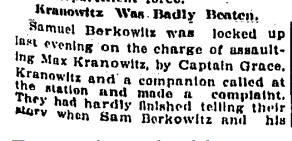
Kranowitz Was Badly Beaten


Special to The Hartford Courant; September 17, 1909
ProQuest Historical Newspapers

"Samuel Berkowitz was locked up last evening on the charge of assaulting Max Kranowitz, by Captain Grace. Kranowitz and a companion called at the station and made a complaint. They had hardly finished telling their story when Sam Berkowitz and his brother-in-law,Sam Waskowitz, hurried in. They were so intent on getting their complaint in first they did not notice Kranowitz and his companion, who were standing over by the window. The captain saw he had a nice kettle of fish on his hands, with the air vibrating with charges and counter charges. He called Kranowitz's witnesses, two others having joined him in the meantime, in his private office, to get as near a correct version as possible. All concurred in the story that Berkowitz had assaulted Kranowitz. According to the story Kranowitz was standing with his friend over by Berkowitz and Waskowitz's new block at the corner of Hartford Avenue and North Street. Waskowitz ordered them away and Kranowitz moved over to the curb. Berkowitz wasn't satisfied, told him that he had no business around there and beat him severely. Berkowitz was taken to the cell room, protesting against the alleged injustice of locking him up. An interesting story is promised in the police court today."
I doubt Max wrote home with news of this beating. A severe beating from fellow Jews may have scared his family from joining him in the States. This article, paints Max not in the pinkish hue of a loving sister. Somehow, despite being the victim in this story, Max seems like a tough guy. He did make it to the police station and not the hospital. Minnie's comment about Max’s revolutionary days comes to mind. The police did arrest the bully, Berkowitz, but the severity of the beating seems disproportionate to the crime of standing on the wrong side of the street. I am beginning to imagine young Jewish hoodlums, marking their territories. Max wasn't alone. He had a companion, and another quickly surfaced at the police station. Why didn't Max and his companion just leave the street like they were told, if they knew this was Berkowitz/Waskowitz territory? Why was Max the only one to take the beating?

There is more to this story, which for now, will just have to wait until Part II of this post. The treasure trail is heating up again and there is surely much more to be discovered. Any leads to obtaining court and police records from this case would be greatly appreciated!

Other posts about Max Crane:
Should Genealogist Spill Family Secrets?
Mystery Monday: Max Crane
Back to Square One
Trail Heating Up Part II
Part III: Why Was Max Hanging Around the Block?
Part IV: The Max Crane Mystery Continues

Wednesday, February 27, 2013

Back to Square One

On Monday Mystery Post, I presented a death certificate I received for a Max H Crane. The post was a call for help from my knowledgable readers. I was hoping to establish whether the certificate belonged to my great-great-uncle Max Hyman Crane. Immediately, I received several helpful replies, and would like to share two of them with you today.

One of two remaining photos of Max seated with his wife Frieda
to his right and baby Milton on his lap. In this photo, celebrating the return
of William Crane from WWI, the Max is the proud head of the family.
(My great-grandmother, his sister Minnie, is standing above Max and Frieda). 

The first reply arrived via e-mail from my cousin Martha who is, herself, an amateur genealogist and a wonderful collaborator. Martha writes:
"Dear Smadar,
 I just read today's installment of the Max Crane Mystery.  The reference to carbon monoxide poisoning which is mentioned might also have come about from an old-fashioned lighting fixture in the tenement.  Could that have been a source for the cause of escaping gas. Illuminating gas, instead of from a kitchen stove or room-type gas heater?
 This is such a dramatic story, and so sad.  If his end was really a suicide, there might be some question of where to bury him, if the family accepted the suicide theory. Without some kind of note or direct declaration to his wife or to others in the family, that might  have permitted him to be buried in a Jewish cemetery.  Usually suicides must be buried outside the walls of the Jewish cemeteries.  
Fondly,
Martha
Martha's assessment of the illuminating gas in the tenements is a reference to the cause of death mentioned in the death certificate (see Mystery Monday: Max Crane) which states the cause of death was "Carbon monoxide poisoning-Illumination-(an illegible word) suicide." I think this is an excellent thought and clearly comes from Martha's insight to life in the tenements. Thanks Martha for this clarification! Martha's other important point was about burial practices for suicide victims in traditional Jewish communities, and again, I'd like to thank her for bringing this up. I was aware of the practice of not allowing suicide victims to be buried inside the walls of the cemetery and kept that fact at the back of my mind when I discovered this grave at the Montefiore Cemetery, clearly marked as part of the I J Morris society (a burial society established by the funeral home I J Morris). I was not aware of getting around the rule when there is no note or direct declaration to the family. Thanks again for this helpful explanation!

The second important feedback I received, was an in-depth blog comment from one of my regular readers +Jacqi Stevens of A Family Tapestry who shared my doubts of the accuracy of death certificates, as well as commiserated with the difficulties of researching ancestors in the vast city of New York. She suggested I contact the cemetery for possibly additional records and recommended two resources I was not familiar with, which turned out to be extremely helpful:
The Brooklyn Standard Union,
Tuesday March 24th, 1925
(Click to enlarge)
Turns out, Jacqi was right! Even tough some families tend to keep suicide quiet, at times, the story makes the news. This one did! I found a mention of the suicide in three New York Papers: The Brooklyn Standard Union, the New York Times and the New York Sun!  

This short article lists a few important facts which are different or not present on the death certificate.
  • Max Crane was a delicatessen dealer- the death certificate lists him as an advertising manager. Max Hyman Crane, my ancestor was neither as far as I know.
  • Home address was 5113 New Utrecht Ave- The death certificate lists the address as 3113 New Utrecht Ave. Pretty sure we are talking about the same Max Crane from the death certificate. 
  • Max Crane's wife was Mary Crane- the death certificate only lists her as Mrs. Crane. Max Hyman Crane' wife's name was Frieda (also spelled Fredda or Freda), not Mary. This pretty much confirms we are talking about another unfortunate Max Crane who committed suicide in New York in 1925 . 
  • The description of how the body was found states that he was seated on two pillows, on a chair near the gas stove which was lit, but not burning. This led the police to conclude it was suicide. 
  • The wife, Mary, stated he had no reason to commit suicide and did not mention it to her, therefore she doubted he took his own life. It's very possible she knew her husband was depressed and why he would have wanted to commit suicide but chose to protect the family from what could have been a very shameful situation. Her public denial of any connection to suicide would have allowed him to be buried inside the cemetery, which explains why the Max Crane from this article was buried inside the Montefiore cemetery. 
  • Missing from this article is a mention of any children. Max and Frieda had an eight year old son. The omission of a child from this article also suggests a different Max Crane.
This finding takes us back to square one. The article confirms my worry that there was more than one Max H Crane who was believed to have committed suicide in New York around 1925. Unless Frieda used the name Mary as well, I am convinced this is not the Max I am looking for. I doubt the article would have changed Frieda's name to Mary in order to protect her privacy, since publishing her address suggest there was little concern for her privacy. Unless proven otherwise, I must assume that neither the death certificate nor the Montefiore grave belong to my relative. They belong to Max H Crane, delicatessen dealer from Utrecht Street in Brooklyn, husband of Mary Crane, who died of a suspicious gas poisoning. I now must re-examine everything I thought I knew about Max's death. 

Recap of the facts regarding my great-great-uncle Max Hyman Crane's death.
  • Max died sometime between 1922 where he was listed in the 1922-23 Hartford City Directory  and June 1925 where his wife Frieda was listed as a widow in the State of New York Census.
  • Max was not listed in the 1924-1925 Hartford City Directory. I assume they both moved, but I have not documented where they lived. They are not in the New York City directory from that period. 
  • Frieda lived in Brooklyn with her brother and sisters as of 1925. I do not know where Max or Frieda lived between 1923 and 1925.
  • It is possible Max died as early as 1923 or 1924 in Hartford and that he never moved to NY with his wife. 
  • Apart from Brooklyn, they may have also lived in Atlantic City where the rest of the Crane brothers lived (since 1920), though they do not appear in the Atlantic City Directory.
  • The family rumor is that Max committed suicide because he was in love with his uncles' wife. The aunt and uncle lived in Atlantic City. 
  • The rumor is that he either drowned himself or died of gas poisoning. 
What next? 

At this point, I have to beging a new search for the whereabouts of Max Hyman Crane's elusive grave —sadly probably sitting outside a cemetery wall somewhere. My plan is to examine both Hartford Publications and Atlantic City. My next stop: Boston Public Library! I promise to keep you all posted.

To read more about Max Crane visit:
Mystery Monday: Max Crane
Should Genealogist Spill Family Secrets?

Monday, February 25, 2013

Mystery Monday: Max Crane

Remember Max Crane?

I shared Max's sad story a few weeks ago in the post Should Genealogist Spill Family Secrets?. His life ended tragically when he committed suicide, leaving behind a wife and young child. The mystery of Max's story continues due to the lack of documentation and information about Max. Much hope was pinned to a death certificate I ordered from City of New York recently. It arrived last week and I've been pondering it ever since. I so hoped to report to you all, that the document I received belonged to "my" Max Crane. Unfortunately, I can't. It seems I'm on a streak of finding interesting, yet inconclusive documents. The good news? These documents make for interesting blog posts! The bad news? There are many more questions than answers related to this certificate. Therefore, once again, I decided to turn to my expert panel of readers for advice.

I present to you the document in question:
Max H Crane
Death Certificate
March 24, 1925
(Click to enlarge).
For your convenience, here is a summary of the information obtained from the death certificate:
  • Name: Max H Crane: consistent with my great-uncle Max Hyman Crane
  • White, married male age thirty-five: all consistent with what I know of Max Hyman Crane who was an Ashkenazi Jew, married to Frieda Levitt and would have been about 35 when he died. 
  • Occupation: Advertising Manager- this is not quite consistent. All I know about Max's work history from my great-grandmother's memoir, city directory, WWI draft record and census documents is that he was a grocery clerk. He did hold other odd jobs including meat cutter. It is possible that he advanced to advertising manager by his last job, but this would be new information to me.
  • Birthplace: Russia. Consistent. I wish this death certificate included his date of birth, but unfortunately it was left blank.
  • How long in the US: seventeen years. Max Hyman Crane arrived in 1905 (according to Minnie's Memoir as well as his immigration papers). He lived in the US for twenty years by 1925 (close enough, but not exactly seventeen years).
  • How long in NYC: 3 years. I know Max moved to NY with his wife and son sometime between the 1920 US census where he lived in Hartford and 1925 when he died in NY. This is consistent, though I don't know when they moved. 
  • Name and birthplace of parents: Isaac and Rebecca both from Russia. PROBLEM!!! Max Hyman's parents were Moshe Aaron and Feige. This completely doesn't fit!
  • Date of Death: March 25, 1925- Consistent. I know Max died around 1925. By June 1st of 1925 Frieda is a widow, according to the New York State Census. She was living at 1379, 54th Street in Brooklyn (with her brother Isaac and several of her sisters). If this truly was Max Hyman Crane, he would have turned thirty-six nine days before he committed suicide.
  • Body was found at: 3113 New Utrecht Ave, Brooklyn- This is consistent with the fact that Frieda was living in Brooklyn in 1925. It's not her brother's address, suggesting that the Cranes lived independently and Fieda would have moved in with her family once she became a widow.
  • Cause of death: Carbon monoxide poisoning-Illumination-(an illegible word) suicide. I'm not sure what illumination means as part of the cause of death, but suicide is consistent Crane family elder's story.
  • Place of Burial: Montefiore Cemetery- Possible. I don't know where Max Hyman Crane was buried. 
The second page of the death certificate states that Mrs. Crane hired the undertakers. Unfortunately it doesn't state her full name.


Page two of Max H Crane death certificate.
(Click to enlarge)

The most glaring problem in this record is the name of the parents which are inconsistent with what I know about Max Hyman. The other inconsistencies are minor (length of time in America, seventeen rather than twenty years, and the occupation). Can a mistake in the parents names be generated by the person who filed the death certificate. Mrs Crane, wife of the deceased hired the undertakers, but did she provide the information or did someone else, for example her brother Isaac? Isaac was living in Brooklyn, and we know he offered her a home once she was widowed  so clearly they were close. He certainly could have been called to do the difficult task of dealing with funeral arrangements. Would he have known Max's parents names? Max's brothers were living in Atlantic City by 1925 and his sister Minnie was in Texas. It's doubtful they provided the information as it's unlikely they would have arrived on time. Frieda herself was probably in a very bad state. Her husband who had been involved in a nasty extramarital affair, had just committed suicide. It's very probable that she asked someone close to her to deal with the logistics. The fact that there is no date of birth, also suggests that someone not so close to Max provided the information. Someone who didn't know his date of birth, which would exclude his wife and or his siblings.

How many other Max H Crane's committed suicide in New York City in 1925? What is the likelihood that this certificate belongs to a different Max H Crane? To answer this question, I scanned the New York City directories. The 1920-21 1922-23 and the 1924-5 directories are available on Ancestry.com. I know Max was in Hartford in 1920, so I didn't need to check 1920. I found no Max Cranes in either the 1922 or the 1925 directories. This implies that, if as the death certificate states Max lived in NY for three years, and if it does belong to our Max, then Max and Frieda, most likely moved to New York, after the 1922 directory came out. (Note to self: trace Max in the Hartford City directories from 1920-1923). The fact that he does not appear in the 1925 city directory most likely means one of two things. Either he just didn't appear in the directory at all (not everyone did), or he died before this directory came out as well. One thing is clear though, despite how common the name Max Crane might be, there were no other Max Cranes in Manhattan or it's boroughs listed in the early 1920s. Therefore there is a very low probability that another resident with the same name committed suicide and could be confused with the Max Hyman Crane I'm trying to identify.

I may never know for certain if this is the correct record. If it is, it does divulge one important piece of information about Max and how he died. The way Max committed suicide is a family myth amongst the Cranes. One story talks about drowning while the other has to do with a gas oven. According to this document, it was carbon monoxide poisoning pointing towards the gas stove scenario.

I have one thought of how to confirm this document. I need to find Max's grave! The Max H Crane from the death certificate is buried at the Montefiore Cemetery, which is in Queens County, NY. Through the cemetery website, I found the exact plot for Max H Crane.  I have created a monument for him on FindAGrave.com, where I've had success in the past obtaining photos of tombstones from helpful volunteers. My hope is that the headstone will contain not only his date of death, but also date of birth and more information such as a Hebrew name or his father's name. My hunch is that Max's siblings may have been involved in obtaining a proper tombstone In Jewish tradition the headstone is unveiled at the conclusion of a one year grieving period. It's very likely that a year later, everyone was far enough removed from the suicide and the anger of the affair, to ensure a proper headstone.

For now, the mystery the handsome Max Crane, the first of the Crane brothers to come to America, continues. As always, I would love to hear from all of you with thoughts and ideas!