 |
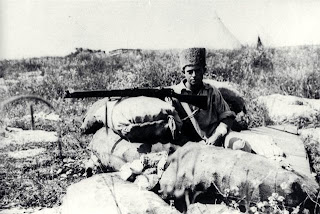
| My Grandfather, on guard duty at his Kibbutz, 1939. |
WARNING! Researching dead relatives can be a lonely endeavor. If you are thinking of researching your family history, consider yourselves duly warned. The genealogist amongst you, surly know what I'm referring to. For the record, please note: as difficult, frustrating and lonely as this pursuit may be, I HIGHLY RECOMMEND GENEALOGY!
Personally, I am far from sharing Tim Tebow's religious beliefs—and as a Bostonian, I could not be happier that the Patriots just ended his amazing run—but I share in his message: Never Give Up and Good Things Will Come. Genealogy is a form of detective work requiring spending long hours alone, perseverance, attention to details and exceptional deciphering skills. Those around you, will rarely understand this crazy obsession with the past. Luckily, for you and for me, the internet is full of other's like us. The good news is, there are millions of Americans—and many more millions around the globe—researching their family history. In my immediate family, everyone is far to busy living their lives. Justifiably, they have little interest or time to study the lives of those who came before them. Yet there is a whole community of professional genealogist or self declared genealogy addicts who are out there sharing their work, offering advice, posting blogs and supporting this amazing and important process. While the process can be frustrating and guaranteed to lead you into many dead ends, I promise it's a journey worth taking. To illustrate how perseverance will result in great discoveries, I want to share with you one of my most remarkable discoveries: records in the
Yad Vashem (Holocaust Martyrs' and Heroes' Remembrance Authority museum in Israel) database exposing information I feared lost forever. Read on, and remember DON'T GIVE UP!
It was two o'clock in the morning, and once again, I was staring at my computer screen, looking for clues about my great-grandparents who died in the holocaust. Four of my eight great-grandparents, lost their lives prematurely in the holocaust. My father, lost all his grandparents before he was born. So little did my grandparents talk about their lost family, that my father—now in his sixties—just did not remember the first names of his long deceased grandparents. "How can you not remember your own grandparents names?" I kept asking. They were people, full of life! They were trapped by history. Living in the wrong place, at the wrong time. Someone needs to remember them. These missing ancestors were a huge hole in
my family tree and my heart.
All I had to go by, was their last names. Yampel and Celnik.
 |
My Great Uncle William Celnik who
Survived Auschwitz and his wife Edith Rose.
. |
On my father's Kibbutz, almost his entire generation grew up without grandparents, uncles or cousins. Like many Kibbutzim, Kibbutz Tel Yitzchak, was founded by young Eastern European pioneers who came to Israel as part of the zionist movement in the early 1930s. As idealistic teenagers, my grandparents left their families and comfortable middle class Polish homes, in pursuit of their dream: creating an independent Jewish state in what was then the dangerous, wasteland of Israel. During World War II, they lost everyone in their family except one of my grandmother's brother's who survived Auschwitz. In 1942, when most European Jews—among them my family—
were obliterated by the Nazi's, my grandparents were in their late twenties and had not started a family of their own. They never determined exactly how they died. For them, there was no closure. No funeral, no shiva (traditional week of mourning), no grave to visit, no death certificate, not even a clue as to where or when exactly their loved ones perished. As I think about the strength it required to commence a family while you are mourning such unimaginable loss, I am overwhelmed.
I must have searched the
Yad Vashem site hundreds of times prior to that night. I searched there and on many other sites,
ancestry.com and J
ewishGen to name a few. Without a first name, or any other identifying clue, it is almost impossible to identify a lost one. I kept probing my father for information and insisting that there must be somewhere we can bring to light the names of his grandparents. After all, they were his grandparents, not some distant relative. Earlier that day, my dad walked in triumphantly and said:" I found some documents. I hope they help." In his hand he held two death certificates belonging to his parents. My expert eyes scanned these documents in amazement, and immediately picked up a very important fact he had completely over looked. Both death certificate, written in Hebrew, listed the name of the deceased's fathers: Leon Yampel and Matias Tzelnik. Finally, I had names. This was a huge breakthrough! Armed with this new information, again I entered
YadVashem.org, hoping to discover something about the two men who gave me life, and whom I knew nothing about. I looked and I looked. Nothing. I tried different spellings.
Nada. And then, as I was about to call it a night, I noticed an option on the search engine which said witness.
It took a little more exploring to understand what this witness option was all about. Yad Vashem, collects testimonies of holocaust victims. These documents are called Witness Pages and are a kind of combination of a birth and death certificate. Despite the German's compulsive record taking practices, millions died during the war without a trace. The Witness Page is a testament to these victims lives and the fact that they existed. Normally these forms are completed by a relative or person who knew the victim and therefore witnessed their life. I had an epiphany. My grandfather, must have documented losing his parents, brother and in-laws.
For many years, grandfather worked as an archivist at a small holocaust museum on his Kibbutz called
Massuah. His job was to record every article that appeared in Israel's newspapers related to the Holocaust. Reading the newspaper at my grandparents home was never any fun. Huge rectangular sections where missing from where a holocaust article carefully removed. In their home, there was an unspoken rule not to discuss the holocaust. As a little girl, I loved my grandfather's stories about the early days of hardships in the state of Israel. My
saba (grandfather in Hebrew), loved tell stories about swarms of malaria infested mosquitos attacking him as he dried out the swamps by planting eucalyptus trees. But if I asked about Poland and his childhood, he would simply brush me off. "That was so long ago, I don't remember." he would retort and quickly change the subject. Yet, the newspaper, riddled with holes, was an ever present reminder to me, that my grandparents never forgot. They carried the weight of the holocaust on their shoulders silently. They wanted to shelter us, never to burden us children with such a heavy cargo. This restraint silence explains my father's inability to recall his grandparents names.
When I saw the witness option, on the Yad Vashem search engine, I knew that my grandfather, with his dedication to documenting the holocaust, must have filed a testimony page in Yad Vashem. Instead of looking for Yampel or Tzelnik, I tried a new approached and searched for Baruch Lavi, the witness. (My grandfather, Born Zigmond Yampel, Hebrewtized his name, around the foundation of the state of Israel. This was another attempt to leave Europe behind). To my amazement, instantly, sixteen records appeared. I looked at the list of names, and there they were. My four great-grandparents, and four great-aunts and uncles, each of their name appearing twice. I clicked on the first one, and read the summary. Then I clicked to see the original document. What I unearthed, was a Witness Page filled out by my grandfather in 1955. By then, after years of searching, he must have given up hope of finding survivors. This document may have been the only piece of closure he had. His familiar hand writing, recorded his fathers name, Leon Yampel—transcribed Jampel (J is pronounced as Y in Polish, a fact I did not know at the time), no wonder I could not find it—date of birth, names of Leon's parents, occupation, last known address, and where Leon may have perished.
 |
| Yad Vashem Witness Page for Leon Jampel my great-grandfather |
 |
My grandfather's brother Michael Jampel
Who perished in the holocaust. He was about
12 years old when he perished. |
Alone, at my desk, tears streaming down my face, I read about my relatives. My beloved grandfather, who did not want to talk about the past, left these records behind for me to discover. That night, I felt he preserved this heritage only for me. I was the only one interested, the only one asking for stories. He understood, that one day, I will be ready to carry the weight of remembering. He understood, that one day, we, his descendants, will need to know. In 1999, when in his eighties, he filled out these forms again, forgetful of the 1950s duplicates. Luckily for me, the new expanded questionnaire provided additional information and clues. My
saba wanted to leave his parents legacy even if it was to painful for him to talk about them. He knew then, what I am only coming to understand now: you can not rush people into the discovery of their past. The understanding that family history is one's own history, comes time and maturity.
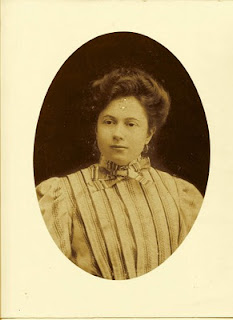 |
My great-grandmother Anna Celnik (Rosenbloom)
Holocaust Victim |
This gigantic breakthrough for a genealogist—finding information about eight lost relatives—meant little to everyone else around me. My dad was very moved of course. My husband congratulated me, but most people did not understand the gravity of this monumental advancement. From these records, I was able to retrace my father's family four generations more. Through much persistance, I began to learn about these relatives, found three surviving photos and reconnected with the descendants of my great uncle who survived Auschwitz. I even found the concentration camp uniform which he donated to the kibbutz museum.
 |
William Celnik's Auschwitz uniform
(photo curtsey of Massuah)
Note the red triangle overlaying the yellow
triangle designated him as a
political Jewish prisoner. |
Many question remain unanswered in my mind. I know very little about these forefathers. I know even less about the circumstance of their death. I am far from closure. So I keep looking for clues, digging for leads. Most importantly, I NEVER GIVE UP and I believe GOOD THINGS WILL COME.
What has been your most amazing genealogical discovery? Please share with us in the comment section. Have you reached a dead-end? Do you need help? Write me a comment!


